The Revelation of the Green-Eyed Vampires’ Origin
Living with 7 vampiresThe Revelation of the Green-Eyed Vampires’ Origin is the pivotal historical disclosure that explains the seven green-eyed vampires’ presence in the mirror and the unnatural silence surrounding them. Jin tells Y/N that the prisoners were once part of the same vampire community as the castle’s remaining inhabitants, but their refusal to accept a ban on hunting humans led to mass murder, insanity, imprisonment, and the destruction of memory. The event changes the story’s central mystery from a question of appearance to a question of buried history: the green eyes mark not an unexplained difference, but the visible aftermath of a violent split within the vampire world.
The Question Behind the Mirror
The revelation begins when Y/N asks Jin why the others are locked away. Jin warns that the explanation will take time, framing the scene as a deliberate act of testimony rather than a casual answer. By this point, Y/N already knows that the prisoners are vampires and that they differ from the others through their green eyes. Jin’s account supplies the missing connection between those visible signs and the castle’s concealed past.
The conversation also reverses the position of knowledge between the characters. Y/N, who entered the castle as a human outsider and was repeatedly forced to interpret unfamiliar beings and spaces, becomes the person demanding an explanation. Jin, by contrast, becomes the keeper of a history that the other inhabitants no longer possess. His hesitation and sigh suggest the burden of recounting an episode that was not merely witnessed but actively suppressed.
A Community Divided by Hunger
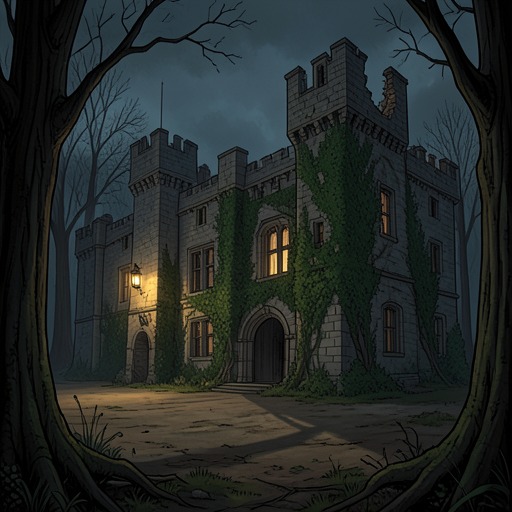
Jin explains that the seven green-eyed vampires once lived alongside him and many other vampires. The community eventually decided to stop attacking humans for blood, fearing that continued hunting would provoke people to pursue and destroy them. The decision established a collective rule intended to preserve the vampires’ survival, but the seven could not accept the restraint. They wanted to leave the castle and hunt again.
The conflict therefore begins as a dispute over appetite, law, and communal security. The seven are not introduced as outsiders who arrived from an unrelated realm; they emerge from the same society as Jin and the others. Their difference is created through conduct and allegiance before it is expressed through the green-eyed condition. When the community prevents them from hunting, the seven initially agree to remain inside and stop attempting to leave. That apparent settlement becomes a deceptive calm rather than a genuine reconciliation.
The Disappearance and the Massacre
After the seven stop trying to go out, the other inhabitants of the house begin disappearing one by one. Jin and the remaining vampires search for them and eventually discover the missing members in the room of the others, all dead. The victims had been drained completely by the seven. This discovery reveals that the prisoners’ violence did not end with their confinement; they redirected their hunger inward, turning the vampire community itself into their source of blood.
Jin identifies a further consequence of drinking from another vampire: it drives the drinker insane. The massacre thus functions both as murder and as a mechanism of corruption. The seven’s attempt to satisfy their hunger destroys the people around them while intensifying the condition that makes them dangerous. Their green-eyed identity is consequently associated with a cycle in which appetite produces violence, violence produces insanity, and insanity makes communal control increasingly difficult.
The survivors try to stop them but fail. Their failure is important because it removes the possibility of an ordinary physical solution. The seven cannot simply be persuaded back into the community, and the remaining vampires lack the power to defeat them by force. The crisis demands an irreversible act from Jin.
Jin’s Sacrifice and the Mirror Prison
Jin says that the only way he could stop the seven was to sacrifice his own power. His account establishes that the confinement was not created by an impersonal property of the mirror; it was the direct result of Jin’s intervention. By giving up his power, he caused the seven vampires to become locked inside the mirror, transforming the reflective surface into a prison and converting personal sacrifice into communal protection.
The act also leaves Jin diminished. Y/N’s question about his powers exposes that the castle’s apparent order rests on a cost paid by one of its members. Jin further explains that the seven each possess a power, although the only one he knew for certain was something like hypnosis. The imprisonment therefore contains not merely violent bodies but supernatural abilities that could have made their return even more dangerous.
Jin used what remained of his power to make the wounded survivors forget that the other people had ever existed. The memory erasure concealed both the massacre and the existence of the prisoners. It protected the survivors from the knowledge of what had happened, but it also removed their ability to understand the castle’s history. The mirror thus becomes a repository for two forms of imprisonment: the seven are confined physically, while the others are confined within an imposed absence of memory.
Consequences and Narrative Significance
The revelation recasts the green-eyed vampires as the consequence of a failed social order. They were once members of the same community, subject to the same dangers and capable of living under the same rules, but their refusal to abandon human hunting turned a protective policy into a civil conflict. The story’s opposition between the castle vampires and the green-eyed prisoners is therefore also an opposition between restraint and predation, remembered history and enforced forgetting, and collective survival and individual appetite.
The disclosure also gives Jin a morally complicated role. He is protector, survivor, and architect of the silence that followed the massacre. His sacrifice prevents further killing, yet his manipulation of memory means that safety is purchased through the removal of truth. Y/N’s request for an explanation begins the recovery of that truth, making the scene a form of historical restoration: the sealed past becomes speakable, and the mirror’s mystery acquires a concrete origin.
Later events continue to expose how unstable that containment is. Y/N is pulled inside the mirror by a shadow, experiencing the boundary between prison and passage as something fluid rather than secure. Much later, Gehan is identified as the ruler of Gehenna, and under a blood-red moon Y/N pushes him away and imagines the gates of hell into existence. Her mother then appears from a blue bubble, while Assiah explains that Y/N had been possessed by her own power; Bambam bears Gehan’s mark after suffering a hole through his chest while trying to stop Y/N. These later revelations widen the scale of the earlier history, connecting the mirror prisoners’ origin to a broader network of possession, curses, supernatural power, and contested memory. The account Jin gives remains decisive because it is the first explanation that turns the green-eyed vampires from an enigmatic threat into the surviving evidence of a catastrophe that the castle tried to forget.